
Is the 2026 FIFA World Cup Living Up to Its Sustainability Promises?
Jun 29, 2026
From sustainability claims to global inequality, why this World Cup feels fundamentally different.
The 2026 FIFA World Cup is the biggest sporting event on the planet this year. Yet, alongside the usual excitement, serious questions are emerging about the tournament’s sustainability, security practices, and whether football can still claim to unite people across political and cultural divides.
The tournament, which kicked off on the 11th of June, has a strange absence of anticipation in the air. The usual fever, the flags, the debates, and the shared excitement, feels significantly muted, almost as though it has been deliberately dialled down. Perhaps it is difficult to summon similar enthusiasm in a year that has already demanded so much of our emotional bandwidth. Parts of the world are living through an active war. We continue to witness the genocidal devastation in Gaza and Lebanon. All the while, the global stage remains cluttered with spectacle—failed space ambitions, recycled political claims, and the noise of narratives that refuse to settle into truth.
It becomes harder, in such a climate, to separate the game from the world that hosts it.
We are living in a moment of deepening polarity, where identity often precedes individuality. Where the visible markers of skin, dress, name arrive before credentials, before experience, before intent. Where your headscarf can enter a room before you do, quietly shaping the terms of your reception. Where language has evolved in ways that allow people to say less while implying more, and where silence can sometimes feel like the safer position than speaking plainly.
In such a landscape, the idea of sport as a neutral ground begins to feel less convincing.
Football Has Never Been Politically Neutral
Football, of all things, has never been neutral. It has always been a political stage, one where identity is amplified, where allegiances are performed, and where power subtly organises itself. Flags are not just decoration; they are declarations. Chants are not just noise; they are messages. Stadiums have long been places where unity and division coexist, often uneasily.
And if sport reflects society, it also absorbs its structures.
What we are beginning to see is not just a shift in tone, but a shift in access. A FIFA World Cup that appears more curated than collective. Ticketing systems that quietly reframe who gets to participate. Entry points that feel less like open doors and more like controlled filters. The language used to justify these systems is familiar—efficiency, safety, regulation—but the outcomes often tell a more selective story.
Who Gets to Participate?
Officials and visitors from several countries across the Global South have reported heightened scrutiny at ports, prolonged questioning, luggage pulled apart under the watch of sniffer dogs. These are framed as precautionary measures, procedural and necessary. But when patterns emerge, neutrality becomes harder to defend.
It is in these patterns that the contradictions sharpen. A Somali referee, widely respected within international footballing circles, reportedly dropped under the broad label of “security concerns.” An Iraqi player was questioned for several hours despite valid documentation. Individually, each case is explainable. Collectively, they begin to suggest something more structured, more deliberate, even if never formally acknowledged.

When participation begins to narrow, when certain bodies are read as risk before they are recognised as contributors, the question is not just about policy, but about pattern. And patterns, over time, reveal intent.
And that same instinct to control who enters the game increasingly extends to how the game is experienced.
Perhaps this is why the tournament feels different. Not because the game itself has changed, but because the world around it has. The distance between what sport promises—a shared global experience—and what it delivers seems to be widening. It raises a quieter, more uncomfortable question: was sport ever separate from these forces, or did it simply feel that way for a time?
Because if there was once a sense of collective belonging, fragile, imperfect, but real, it now feels like it is being tested. Whether that sense was the result of genuine progress or simply a momentary alignment is difficult to say. What is clearer is that the illusion, if it was one, is harder to maintain.
Sustainability Claims vs Reality
Let’s also not forget that FIFA initially prohibited fans from bringing reusable water bottles into stadiums, while ultimately permitting a single sealed disposable plastic bottle after widespread criticism. On the surface, it was a procedural decision; standardised regulations, risk mitigation, crowd control. But it sits uneasily alongside the language of sustainability that the tournament so readily promotes. Because if environmental responsibility were truly central, discouraging reuse in favour of disposability feels less like a compromise and more like a contradiction.

What makes the contradiction even harder to ignore is that previous tournaments actively encouraged reusable drinking systems. During Qatar 2022, FIFA distributed more than 43,000 reusable water bottles and installed approximately 290 refill stations, estimating that these measures avoided the consumption of over 300,000 single-use plastic bottles. Yet four years later, at what is expected to be the largest FIFA World Cup in history, the message appears to have shifted. In that context, restricting one of the simplest sustainable behaviours available to spectators feels emblematic of a wider problem. When hydration becomes something you must purchase rather than carry, and sustainability becomes something you are shown rather than enabled to practise, it raises a familiar question: who is this World Cup really designed for, and at what cost?
The Environmental Cost of the World’s Biggest Tournament
Analysts have estimated that the expanded 2026 tournament, spread across three countries, could generate as much as 7.8 million tonnes of CO₂ emissions, more than double the footprint of Qatar 2022.
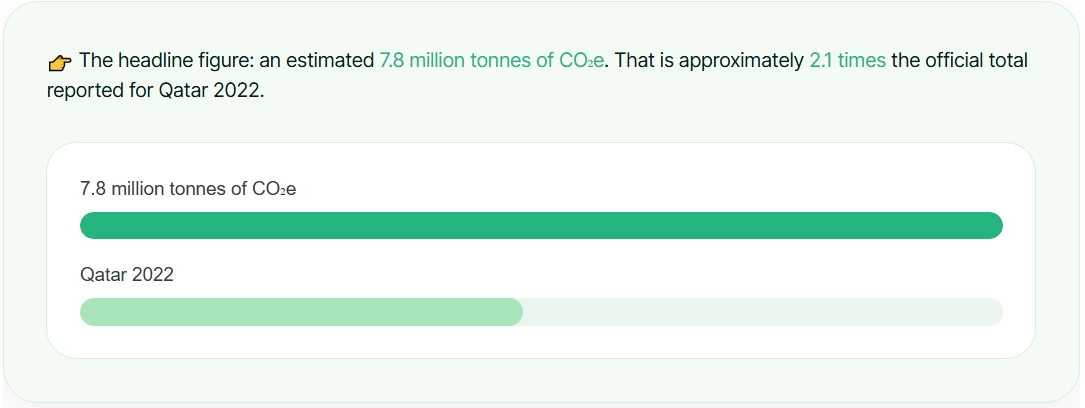
The 2022 FIFA World Cup in Qatar was responsible for an estimated 3.8 million tonnes of CO₂ equivalent emissions, with travel, accommodation and infrastructure accounting for almost 95% of the tournament’s footprint. FIFA's own reporting acknowledged the scale of the challenge.
In 2026, senior FIFA officials, commercial partners and tournament executives will criss-cross host cities and countries throughout the tournament, adding to the emissions burden of an already carbon-intensive tournament. Yet these emissions rarely attract the same scrutiny as the sustainability measures expected of spectators. Sustainability, it seems, is often expected of spectators long before it is expected of those in power. Environmental responsibility then increasingly feels curated, visible where it can be marketed, measurable where it can be certified, but negotiable when it collides with commercial or operational priorities.
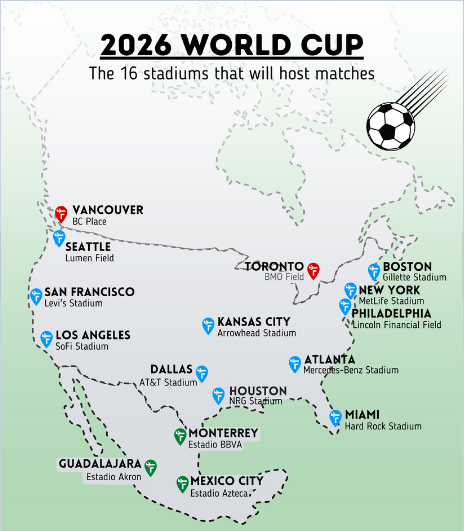
The contradiction extends far beyond what fans are allowed to carry through the turnstiles. The greatest environmental cost of any World Cup has never been the reusable bottle in someone's backpack—it has always been the movement of millions. The aviation emissions from players, officials, sponsors, media and supporters travelling between matches across three countries will dwarf the impact of any individual behavioural change. Add to that the construction and retrofitting of stadiums, temporary fan zones, the mountains of tournament merchandise produced for a single summer, and the tonnes of food that will inevitably be wasted across hospitality suites and event venues, and the scale of the challenge becomes impossible to ignore.
Yet these are rarely the sustainability conversations that dominate headlines. Instead, we are encouraged to recycle our cups, separate our waste correctly and applaud incremental initiatives while the structural drivers of emissions remain largely untouched. It is a familiar pattern in environmental discourse where responsibility trickles down while accountability rarely trickles up. Fans are asked to make better choices. Cities are expected to absorb the costs. The planet quietly absorbs the consequences.
Perhaps that is why sustainability at events like the World Cup can sometimes feel performative rather than transformative. It is easier to change what the public can see than to confront what the public cannot. But climate change is indifferent to optics. It measures emissions, not intentions. And if football truly wishes to lead on sustainability, then the hardest conversations should begin with the biggest sources of impact, not the smallest.
Can Football Still Unite the World?
If this World Cup reminds us of anything, it is that meaningful sustainability is measured by systems, not slogans. Read our article on why organisations need a fundamentally different approach to sustainability to achieve real environmental impact.
Football remains one of the few experiences capable of bringing billions of people together. That makes every decision surrounding the tournament—from environmental policy to accessibility—far more significant than a simple sporting regulation. If football truly belongs to everyone, then sustainability, fairness and inclusion should not be optional extras. They should be part of the game itself.
And so, as the FIFA 2026 World Cup continues, it does so in a world that is watching differently. Not just the matches, but the margins. Not just the goals, but the gates that decide who gets to see them, and not just the green claims, but also the action taken behind them.
Key Takeaways
- The 2026 FIFA World Cup raises important questions about sustainability, accessibility and inclusion.
- The tournament's environmental footprint extends far beyond spectator behaviour to aviation, infrastructure and global travel.
- If football is to remain a truly global game, sustainability and fairness must be embedded into its systems, not simply promoted in its messaging.
- Nazia Husain is a sustainability professional at Fifty Shades Greener, writing about sustainability, ESG, climate policy and the intersection between sport, society and environmental responsibility.
Author