When Clicks Are More Important Than People and Planet: The Real Cost of Clickbait
Aug 21, 2026
By Raquel Noboa, Founder & CEO, Fifty Shades Greener
I believe passionately in freedom of the press and I believe we need journalists who investigate governments, challenge corporations, expose wrongdoing and tell us things that powerful people would rather we didn't know.
But freedom of the press cannot mean freedom from responsibility…And something has gone badly wrong ☹
Over the past few weeks, I've found myself becoming increasingly angry at headlines appearing across parts of the British and Irish media. Not because I disagree with an opinion, disagreement is healthy, but because increasingly I see complicated scientific issues, human tragedies and people's lives being turned into something designed primarily to make us click.
And clicks make money.
The more frightened we are, the more outraged we are, the more disgusted we are, the more likely we are to click, comment and share. So perhaps we need to start talking about the business model behind the information we consume. Because whether we're talking about traditional media or social media, the currency is increasingly the same:
Our attention.
And there are consequences when profit comes before people and planet.
Did rewilding cause the UK wildfires? Apparently so, if you believe the headlines
Britain has experienced devastating wildfires this year. Climate change is creating hotter and drier conditions that increase wildfire risk, but land management absolutely matters too. This is a complex issue that deserves proper discussion. But of course, complexity doesn't make a great headline! So instead we get headlines suggesting that Britain's wildfires are the result of "eco-dogma" and rewilding.
Think about what happens when you reduce an enormously complicated environmental issue to that. Suddenly the environmental solution becomes the environmental problem. Rewilding becomes the villain and Climate change disappears into the background. Readers walk away with a completely different understanding of what is happening, and this is a very dangerous position. Are we gone mad???
The information people consume affects the politicians they vote for, the policies they support and ultimately our ability to respond to climate change. There is a perfectly legitimate debate to be had about how land should be managed to reduce wildfire risk. Have that debate, but give people the whole bloody story at least!
Cleaner air is causing heatwaves?
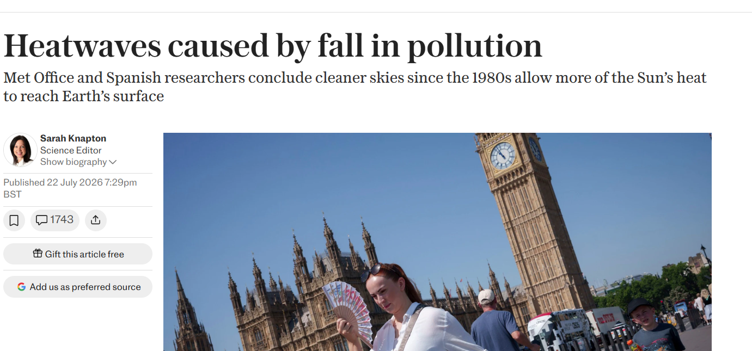
Then came another extraordinary headline: "Heatwaves caused by fall in pollution."
Imagine reading that while drinking your morning coffee. We've spent decades trying to reduce air pollution because it kills people, damages our health and harms the environment, and suddenly cleaner air is responsible for the extreme heat? Except, of course, that isn't what the science actually says. There is interesting science here. Some aerosols in polluted air reflect sunlight and have historically masked a portion of greenhouse-gas warming. Reducing those pollutants can therefore reveal some of the warming that was already being masked.
That is fascinating, but it is also very different from telling millions of people that cleaner air causes heatwaves.
Greenhouse gases remain the dominant driver of global warming. But which headline gets more clicks?
"Scientists examine the complex interaction between declining aerosol pollution and greenhouse-gas-driven warming."
Or:
"Heatwaves caused by fall in pollution."
And therein lies the problem.
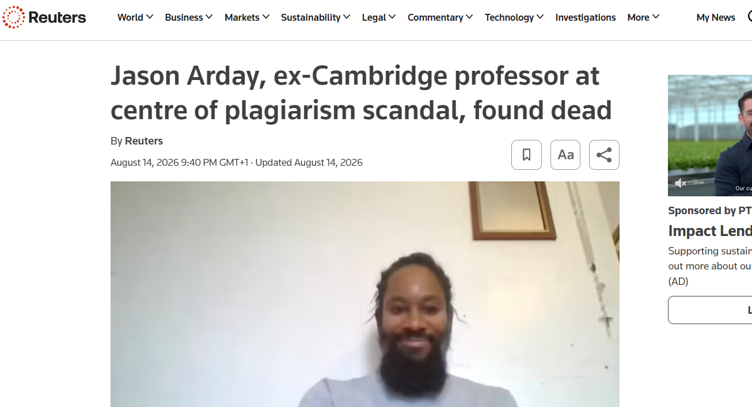
Jason Arday: When media scrutiny becomes a pile-on
This isn't just about our planet, it is also about people.
Professor Jason Arday was a hugely prominent academic who became Cambridge University's youngest Black professor. Then allegations were made about aspects of his academic work and personal story. Those allegations absolutely deserved proper investigation, but what happened next should make every one of us uncomfortable.
The story became enormous. Hundreds of articles appeared within weeks. His name, career, personal history and reputation became content for an enormous media machine.
Jason Arday was subsequently found dead.
I am deliberately not saying that the press caused his death, because none of us has the right to make that causal claim without evidence, but I am asking something else.
At what point does legitimate scrutiny become a pile-on?
At what point does the person at the centre of the story stop being a human being and become a commodity? At what point does another headline stop serving the public interest and start serving the traffic figures? We have been here before.
Caroline Flack's death in 2020 forced Britain to have many of these same conversations about media intrusion, online abuse and the way we collectively treat human beings when their worst moments become public entertainment. And yet here we are again.
Five young people died on the M9. What are we learning from it?
And then came the horrific M9 crash in Ireland, five teenage boys died and four innocent people travelling in another car were seriously injured.
Driving the wrong way down a motorway is unbelievably dangerous. There is absolutely no excuse for putting innocent people's lives at risk and those boys made a terrible decision.
But they were also teenagers, they were someone's sons, and I don't know about you, but I remember being young: I loved a dare, I did stupid things, I thought I was invincible. The difference is that I didn't have an algorithm in my pocket potentially rewarding me for increasingly outrageous behaviour.
That is the conversation I want us to have.
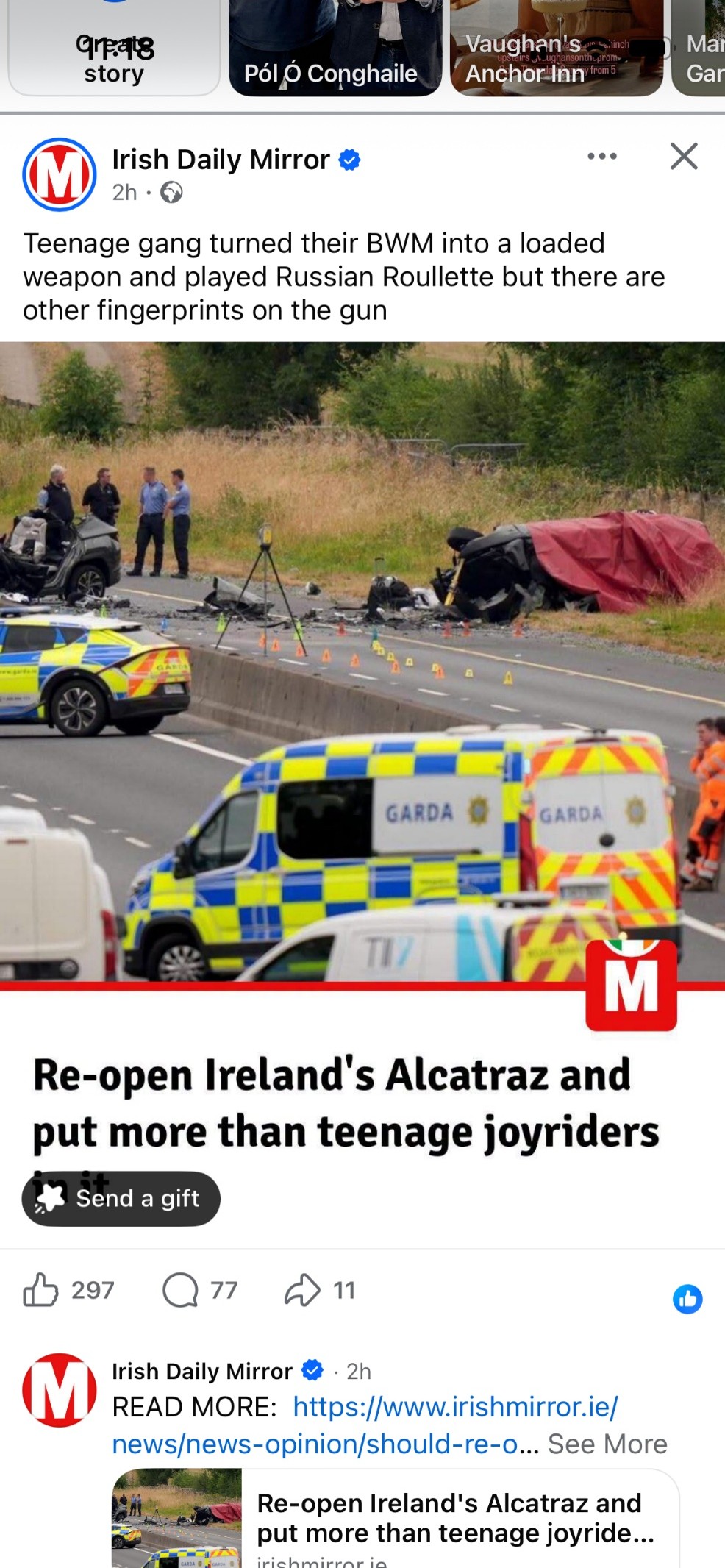
Garda Commissioner Justin Kelly has explicitly spoken about cases of people driving the wrong way on motorways for social-media likes. So we need to stop treating social media as though it is simply a neutral noticeboard where young people happen to post stupid things. These are extraordinarily sophisticated commercial platforms, their algorithms decide what gets amplified, engagement is monetised, attention is monetised, virality is monetised, and dangerous behaviour can become content.
A teenager sees somebody doing something outrageous, it gets thousands of views, someone else goes further, more views, someone else goes further again, where does that escalation end?
And then something even more disturbing happens. The same attention economy that may have helped encourage the behaviour gets to monetise the tragedy afterwards. Videos circulate people comment, newspapers publish increasingly sensational details about the teenagers, people become furious, people click, comment and share, and some of the comments I have seen are disgusting.
The press and social platforms make money from our attention, but there are families burying their children. Let that sink in, cause 1 of those 5 teenagers could have been your son.
Who exactly is protecting us?
This is the question I keep coming back to: Where is our protection?
We have consumer protection legislation because we recognise that there is a power imbalance between corporations and individuals, companies cannot simply put whatever they like on packaging, advertisers cannot make whatever claims they like, financial products are regulated, medicines are regulated and Environmental claims are increasingly regulated (Thank god for this one!).
Why?
Because governments recognise that misleading information can cause harm. So why does that principle suddenly become so complicated when the product being sold to us is information itself? Why aren't we having a much bigger conversation about the responsibilities of companies whose algorithms and headlines influence what millions of people believe and how they behave?
And I don't accept that the answer is simply: "Freedom of speech."
Freedom of speech is fundamental, and freedom of the press is fundamental, but neither should mean freedom from accountability.
I'm not asking governments to decide which opinions newspapers are allowed to publish. I'm asking why companies can repeatedly profit from misinformation, humiliation, outrage and potentially harmful amplification while society is expected to simply absorb the consequences.
In sustainability we talk constantly about balancing People, Planet and Profit in that exact order. Maybe it is time we applied exactly the same thinking to our information industry.
Because profit isn't inherently bad, newspapers need revenue and technology companies need to make money. But when Profit consistently wins at the expense of People and Planet, something is fundamentally wrong with the system.
A newspaper should not need to distort climate science to make environmental stories interesting. A human being should not have to become profitable content during the worst period of their life. And a social-media company should not be able to shrug its shoulders when algorithms amplify behaviour capable of getting young people killed.
Governments regulate businesses precisely because markets do not always protect people by themselves.
So where are our governments?
Where are our regulators?
Where are our consumer protection agencies?
And perhaps the most uncomfortable question:
Who are they actually protecting?
Because sometimes it feels as though enormous effort goes into protecting the freedom and commercial interests of media organisations and technology platforms, while ordinary people are left to deal with the consequences.
Five teenagers are dead, a family travelling innocently on the M9 has suffered horrific injuries, a 41-year-old professor is dead following weeks of extraordinary public scrutiny and our climate crisis is being turned into culture-war clickbait.
How much more damage do we need before we accept that the information economy needs accountability too?
Neither journalism nor Social media should require us to sacrifice truth, dignity or human wellbeing in exchange for corporate profit.
People. Planet. Profit. In that order, and right now, I think parts of our information industry have got that order catastrophically wrong.
Author